


Retrieving for Gundogs: Building Confidence, Control and Partnership
A beginner-friendly guide to developing a reliable, happy retrieve from first dummy to polished delivery.

Retrieving is next to hunting at the heart of our gundog work, but a good retrieve is much more than a dog running out and picking something up. It is a chain of behaviours: steadiness, marking, hunting, picking up, returning directly, holding calmly and delivering tenderly to hand. When each link is taught carefully, retrieving becomes a shared language between dog and handler rather than a contest of speed, possession or excitement.
Using Simone Mueller’s description of the predatory motor pattern, the natural hunting sequence can be understood as orient > creep > stalk > chase > grab-bite > kill-bite > possess > dissect > consume. From an intrinsic perspective, each stage can be rewarding in itself. Orienting is the dog noticing potential prey and directing attention through sight, scent or sound.
Creeping and stalking involve slow, controlled movement towards the target. Chasing releases pursuit drive and speed. Grab-bite is the act of taking hold, while kill-bite, dissect and consume belong to the later, more predatory end of the full sequence. Possess is especially relevant to retrieving because it is the point at which the dog has the object and could keep it. Gundog training works with the early and middle parts of this sequence while carefully reshaping the outcome: the dog is encouraged to orient, hunt, chase, pick up and carry, but then return and hand the object over to a human partner.
That handover to a different species is remarkable because it asks the dog to move beyond instinctive possession and into cooperation, trust and shared purpose.
Start with the foundations
Before increasing distance or adding distractions, make sure your dog understands the basics: recall, sit, stay, heelwork and engagement with you. A retrieve relies on well-trained behaviours before and after the pick-up. If a dog will not come back reliably without a dummy, it is unlikely to come back better when carrying something valuable.
Keep early sessions short, upbeat and successful. Use a paint roller, soft puppy dummy or small canvas dummy, choose a quiet area and end while the dog is having fun and still wants more. The aim is to build desire without creating chaos.
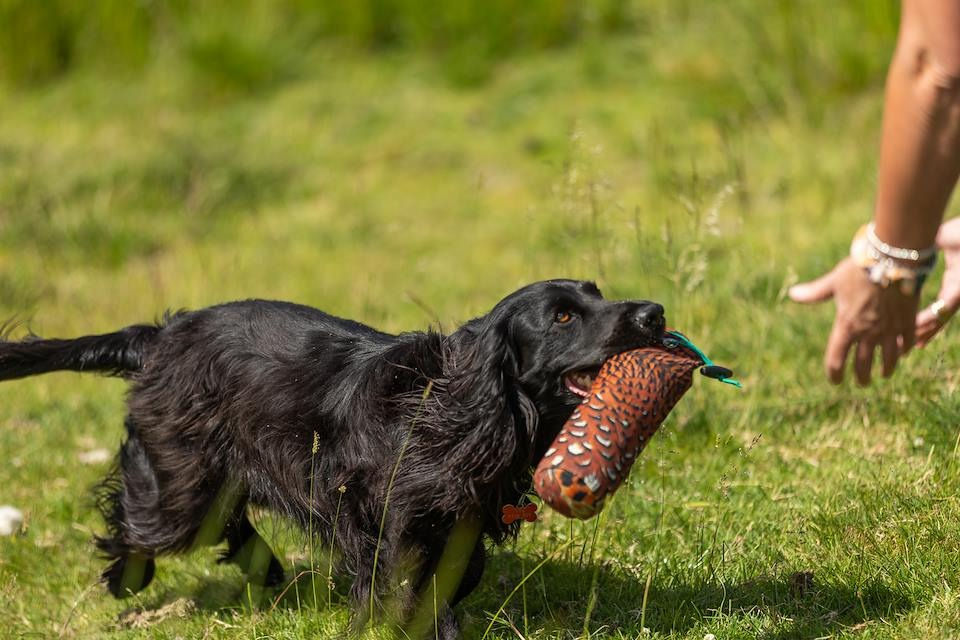
Teach the retrieve in stages
Interest: Let the dog enjoy the dummy. Encourage a clean pick-up without snatching it away too quickly.
Hold: Reward calm holding. Avoid turning every delivery into a tug or chase game.
Return: Move backwards, use a warm voice and make coming back to you rewarding.
Delivery: Ask for the dummy calmly and praise/reward the dog for placing it into your hand.
Steadiness: Only send the dog when released, so the retrieve begins with permission rather than impulse.
Marking, memory and blind retrieves
Retrieves are grouped into seen, memory and blind retrieves.
In a seen retrieve, the dog watches the dummy or game fall and is sent to the area it has marked, building confidence, focus and accuracy. A marked retrieve teaches the dog to watch where the dummy falls, run to the area and pick it efficiently. Start with simple throws on short grass where the dog can see the fall clearly. As confidence grows, vary the ground, distance and angle.
In a memory retrieve, the dog has seen the fall or placement, but there is a time delay before being sent; this develops patience, steadiness and the ability to hold information while working with the handler. Place a dummy while the dog watches, walk away together, then send the dog back. This develops trust, confidence and the ability to hold a line. Build gradually; too much complexity too soon can make a young dog hunt wildly or doubt the handler.
In a blind retrieve, the dog has not seen the fall and must trust the handler’s direction, line and cues to find it. Blind retrieves are where the partnership becomes most visible, because the dog is working towards something it has not seen and must rely on the handler’s information. When introducing blind retrieves, make the first blinds almost “too easy”: use a familiar area, a short straight line and a clear reward history so the dog learns that following your cast or line leads to success.
Build distance, cover and uncertainty slowly, and return to simpler setups whenever confidence drops. Together, these three types of retrieve move the dog from using its own eyes and memory towards a deeper partnership in which handler communication becomes essential.

The importance of delivery to hand
Delivery problems often start when the handler puts on too much pressure, reaches too quickly, grabs at the dummy or chases the dog. Instead, invite the dog into your space, keep your hands calm and reward the moment of sharing. A dog that feels safe bringing the retrieve to you is far more likely to deliver cleanly. If your dog circles, drops short or holds on, go back a step. Practise short retrieves in a narrow space such as a hallway or fenced track, where returning to you is the easy choice. Reward generously and avoid turning the dummy into something the dog must protect.
Adding whistle and handling skills
Whistle cues give clarity at distance. Many handlers use multiple short pips for recall and a single clear stop signal for sit or stop, but the exact pattern matters less than consistency. Introduce whistle cues alongside behaviours your dog already understands, then reward correct responses before expecting them in more exciting environments.
Once the stop whistle, recall and basic directional cues are reliable, you can begin simple handling drills. Keep them fair: set the dog up to succeed, use visible dummies at first and avoid sending repeatedly into uncertainty. Good handling is built on trust, not guesswork.
Common retrieving mistakes
Throwing too many retrieves and creating over-excitement.
Increasing distance before the return and delivery are reliable.
Grabbing the dummy, which can make the dog avoid the hand.
Training in distracting places before the behaviour is secure.
Using the whistle inconsistently or repeating cues until they lose meaning.
Final thought
A reliable retrieve is not produced by rushing; it is shaped through small, successful repetitions. Keep the dog confident, protect the delivery, reward partnership and progress only when the previous step feels easy. Done well, retrieving becomes more than a skill. It becomes one of the clearest ways your gundog learns to work with you.


Comments