


Introducing Your Dog to Your New Baby: How to Prepare for a Smooth Transition

Training & Behaviour
With a surge of baby bump announcements happening around me recently, I thought it would be useful to explore what we can do to prepare our dogs for the arrival of a new baby. Pregnancy is a unique and beautiful journey, filled with anticipation, wonder, and the joy of nurturing new life; embracing each moment allows you to cherish the miraculous changes and the excitement of welcoming your little one.
One of the incredible, amazing things about dogs is their noses. They detect and recall scents long after exposure. When a person is pregnant, hormones in their body alter their scent. So, can dogs sense pregnancy? Because of their keen sense of smell, many people believe that dogs can detect a change in a pregnant person even before the person does, but this is mostly conjecture.
Dogs have sixty times as many smell receptors as humans, and forty times as much brain power dedicated to smell. These scent receptors allow them to differentiate 30,000 to 100,000 aromas. Dogs possess an extraordinary ability to interpret and analyse scents, thanks to the significant portion of their brain dedicated to processing odours. This heightened sense of smell enables them to detect a wide range of chemical changes in their environment.
Dogs can detect scent changes from medical conditions like cancer or insulin level shifts. In addition, their acute noses can identify substances like explosives and drugs, as well as physiological changes in people, such as those occurring during the menstrual cycle or pregnancy. This remarkable olfactory sensitivity often leads to noticeable changes in a dog’s behaviour when they sense something different about the people around them.
We cannot know for sure the exact moment a dog senses a pregnancy. However, we do know that not much gets by the canine nose. Although your dog can detect a change in scent, it is unlikely they comprehend the reason for the change. What dogs do understand is that something is different, both on a physical and behavioural level. It is only natural for them to take notice and show an interest. Dogs are extremely sensitive and intuitive in studying behaviour and subtle movements.
It is difficult to say how dogs will react to their owners’ pregnancies; some may become protective, others may be fearful, or even completely indifferent. Many pregnant people report that their dogs are more affectionate or protective during their pregnancy. This is due to the scent and hormones, as well as changes in emotions. Changes at home can influence a dog.
Dogs are smart enough to notice changes during pregnancy, both in a physical way, which is how the body shape of a pregnant woman changes, how she moves, and how she smells, and in an emotional way, such as feelings and moods. Preparing your dog before the baby arrives will help for a smoother transition in lifestyle when the newborn baby arrives. Dogs will adapt to new environments and routines; however, some dogs may have a slower transition, requiring a little extra care and attention.
When babies come into the mix, as much as we like to think that the routine for our dogs is not going to change, it will. Your dog does not need to feel left out or upset if their routine changes. What we want to be doing is preparing our dogs for those changes that will inevitably take place, so that it causes little upset to our furry friend. By putting in the work ahead of the arrival time, we can help our dogs adjust and thrive in a new routine.
One of the best things that you can do for your dog is to help prepare them for the changes that are going to happen. Do not leave this to the last minute, as adapting to changes takes time.
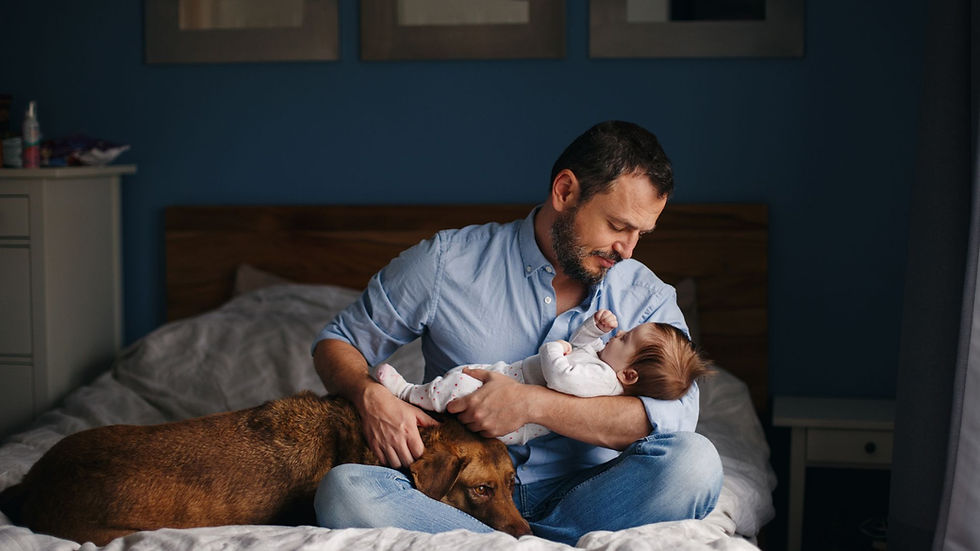
Pregnancy bump with a dog
Here are some suggestions to help set your dog up for success when it comes to expecting and introducing a baby.

1. Dogs’ walks:
As much as it is your intention to manage a dog's daily exercise routine, things will happen that can prevent you from fulfilling this. After childbirth, particularly following complicated deliveries, a new mother will go through a recovery period that may limit her ability to exercise with your dog, either resting or being busy with the new baby.
Also, if you do not know it yet, you will be sleep deprived. In the first few weeks of having a newborn baby, it is a case of survival and getting through each day until a routine falls into place with the baby. There will be days when you are simply too tired to want to get up and take the dog out for a walk.
The weather also may not be favourable, and though previously you may have walked the dog in all weathers, you may feel a bit different to taking a newborn out in the snow or when it is windy and / or raining heavily. If the dog's routine of daily long walks changes when the baby arrives, it may affect the dog's behaviour.
For some dogs, a sudden change in routine can cause anxiety, stress and/or over arousal issues. As a result, this may create unwanted behaviours such as destroying something they should not, pacing, whining, and jumping all over the place.
And believe me, when you are super tired and have your hands full managing a crying baby, it is going to be hard to deal with the dog's behaviour too. So, start preparing for some of your dog’s expectations by reducing the dog's daily amount of exercise.
2. Exercise routine:
Dogs quickly learn to expect their usual walking routine, whether by distance or duration. Dogs are quick to notice patterns, and when they expect the same type of exercise at the same time each day, it can make them less adaptable to changes in daily life. This expectation can pose a challenge, especially when circumstances shift, such as the arrival of a new baby, which may disrupt your previous ability to maintain the same walking schedule.
It is important to avoid creating a rigid exercise routine for your dog, particularly in the period leading up to the arrival of a new baby. Start changing the times around and try to be unpredictable with this, as we do not want to be setting a dog into another set routine. Vary both the duration and the intensity of your dog's exercise. You might walk your dog for a long time one morning, take a short evening stroll another day, or even skip a day.
Mixing in different types of exercise, such as a leisurely walk around the block on lead or a faster-paced outing with some off lead time, helps your dog become more adaptable to change. By regularly altering the timing, type, and length of your dog's walks, you help prevent your dog from expecting a set routine. So, do an hour's walk one day, but the next day it may only be 20 minutes, followed by a rest day.
Then, on the fourth day, the dog may get a 40-minute walk. This unpredictability prepares them for the changes to come once the baby has arrived. Some days may involve more vigorous activity, like running or off-lead play, while others may be gentler or shorter in duration. This approach helps reduce the likelihood of anxiety or stress in your dog when circumstances make it difficult to maintain their usual exercise habits.
To help your dog better cope with upcoming changes, it is important to gradually introduce unpredictability into their exercise routine. By alternating the timing, duration, and type of walks, you teach your dog to be more flexible and less reliant on a strict schedule and adapt more readily to big life changes a new baby brings.
I know humans like routine, but the unpredictability will help set your dog up for what is to come once your baby has arrived.

3. Increase rest, sleep, and overall calmness.
Sometimes, with reduced exercise, we can feel guilty and overcompensate by providing lots of other ways to keep them entertained. As much as we can and should include other forms of enrichment to stimulate our dog, we also want to show them that resting and sleeping is ok too. I always recommend to my clients that they provide their dog with a safe and quiet space of their own. A space that the dog can take themselves off to and rest when needed.
Because when you have a newborn, especially in the first few weeks, it is going to be hectic. Friends and family may visit. There will be many gifts and food to support the new mother. You will be holding your baby in your arms and lap for many hours a day, and there is little space around you for the dog at times, too. If you have not prepared your dog for this, it can certainly feel like you are pushing your dog out of the picture. So, prepare them for it.
Give them their own space where all good things happen. A crate, play pen or a gated room with their favourite items is ideal. They get food, treats, a comfortable bed, toys, and we make sure it is their own space. If your dog is not crate trained and a crate is new to them, it is important to plan and allow enough time for crate training. If your dog is older and you have not used the crate for a while, I recommend reintroducing the crate as a quiet space for the dog. Make the crate the best place to be for your dog.
4. Supervision and Safety Around Babies
Regardless of a dog's level of training or familiarity, it is not advisable to leave any dog unattended with an infant or child. These guidelines are crucial for times when you are unable to supervise the dog with the baby, such as when taking a shower. Preparing your home with safety gates or crates allows you to separate the dog for short periods, like when you need to nip to the loo, answer the door, or check the food in the oven. This ensures the safety and wellbeing of both your child and your dog. So, prep your house, have safety gates up or crates in place.
5. Introducing the Dog to the Idea of You Carrying a Baby
It might feel a bit awkward or even embarrassing at first, but it is important for your dog to become accustomed to the sight of you carrying a baby. By practising carrying an object, such as a doll or a teddy and using a baby sling, you help your dog adjust to this new behaviour before the baby arrives. The goal is for your dog to see you carrying something in your arms and regard it as entirely normal, rather than something exciting or unusual.
This makes the experience far less novel for the dog when you eventually bring your baby home and ensures that your dog remains calm and relaxed rather than overly interested or stimulated by what you are carrying. We want the dog to practise being calm around us, holding something in our arms and on our lap. We do not want a dog that is super excited to see and get to whatever it is you are holding.
This can create a dog that is jumping up, trying to grab and potentially nip at what you are holding. And at some stage, that is going to be a baby. Carrying an object, as if you are carrying a baby, should feel entirely routine for your dog and not present as something unusual or exciting. It is essential that your dog becomes accustomed to seeing you with something in your arms prior to the baby’s arrival.
This familiarity will help prevent the dog from perceiving the baby as a novel or stimulating presence, thereby reducing the likelihood of overexcitement or unwanted behaviours such as jumping up or trying to investigate what you are holding. By regularly practising carrying a doll or a similar object, and even using a baby sling, you encourage your dog to see this as part of everyday life. The aim is for your dog to regard you carrying an object as perfectly normal, ensuring they remain calm and settled when the real baby arrives.
6. Get the dog used to baby noises.
Your dog may have never experienced the piercing sound of a baby crying, and babies can cry for lengthy periods sometimes. Trust me, you cannot just switch it off (I have searched for the off button myself)! Play baby sounds softly in the background so the dog can hear them without reacting. By doing this, your dog gradually becomes familiar with baby noises, including crying, without becoming overexcited or stressed.
The aim is to ensure that the sounds are present enough for the dog to notice, but not so loud that they become a source of excitement or anxiety. This gentle exposure will help your dog adjust to the new sounds before the baby arrives, making the transition smoother and less overwhelming for your dog. We want the sound of the baby to become everyday background noise, like the tv or washing machine in the background.
When you are playing these noises, you can train your dog for calmness and settling in their safe space or crate. You can play games with the dog or give them a chew, Kong, or Licki mat. Turn up the level of the crying sounds over the space of a few weeks. The aim is for the dog to remain calm and settled around the noise of a crying baby.
7. Train the dog a “move away” or “to bed” cue.
There are going to be times that you need the dog to walk away, to get out from under your feet and give you space. If you are not yet aware, I am going to give you a real-life example of why these cues are useful. There will be times when the baby has what is called an explosion, and if you don't know, this is where poop has leaked from the nappy, potentially going up the baby’s back (real life lessons here ;), and you are going to need to be very hands on with the baby and control this situation.
In moments of sudden stress, such as when dealing with a nappy explosion and feeling overwhelmed, the last thing you need is your dog getting in the way or adding to the chaos. Make sure your dog can give you space to help prevent complications. By training your dog to respond to cues such as “move away” or “to bed,” you can create the distance needed to manage these situations calmly and efficiently, reducing the risk of frustration or panic.
This approach not only keeps your baby's environment safer but also helps prevent the dog from inadvertently becoming part of the problem during these hectic moments.
We do not want a dog that wants to be involved, and we need to be able to create space. In stressful moments, we may instinctively shout at the dog, even though he is not at fault. So, we should teach the dog a behaviour, which creates a little bit of distance, giving us time to sort things out as stress-free as possible.
8. Baby sling/pushchair
Just like training your dog to walk next to the pushchair, you want to teach your dog to walk next to it and be familiar with collapsing, erecting, and storing it. Teaching your dog a reliable sit/stay makes it easier to manage shopping bags, your baby, the pushchair, and your dog at once. You are going to have to multitask, and this can be stressful at times. Rehearsing different scenarios can help to prepare you and your 4-legged companion for these situations.
The arrival of a new baby in the household alters the dynamics among family members and may introduce periods of significant stress, particularly during the initial stages. Training for the situation rather than in the situation. Many dog enrichment ideas are available online, and some can be prepared in advance.


Comments